
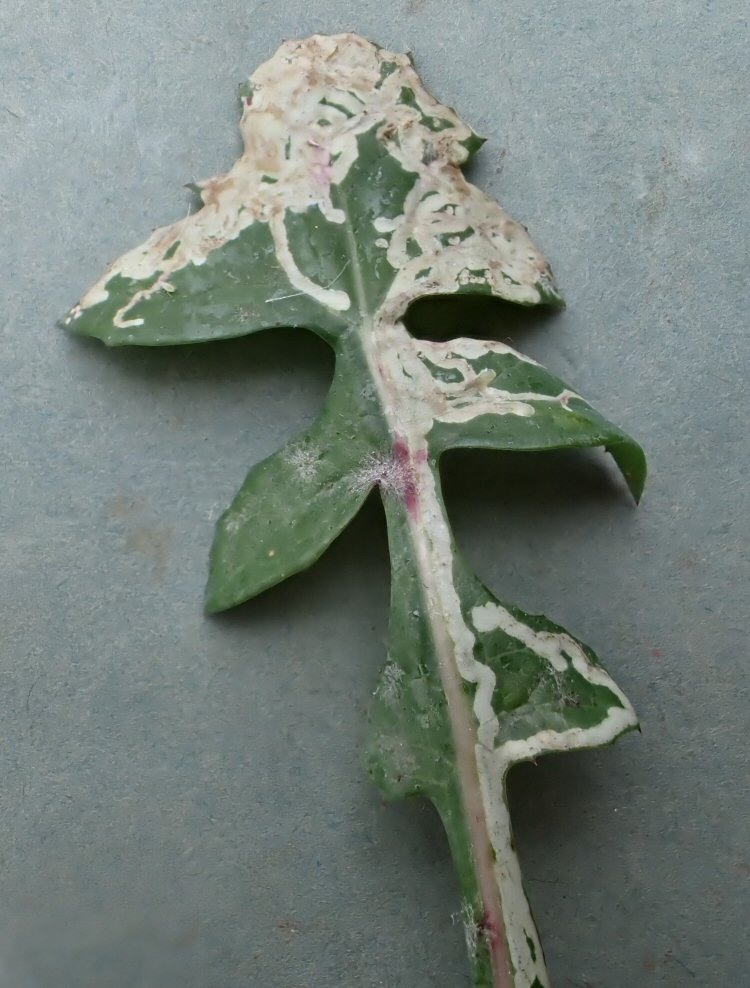
Food Plant: Asteraceae: Arctium pubens, Arnoseris minima, Chrysanthemum argyrophyllum, Inula crithmoides, Leucanthemum vulgare, Leontodon autumnalis Bland, Senecio arvensis, Senecio asper, Senecio jacobaea, Sonchus oleraceus, Serratula tinctoria, Tanacetum vulgare, Taraxacum, (Daisy family)
Mine: Summer
Pupa: Is normally white, but can be brown . The
anterior spiracles project through the leaf epidermis
Notes: The larva forms a linear mine and then pupates
at the end of the mine. Widespread
and common throughout Europe. There are two polyphagous miners which
form indistinguishable mines on a large number of plant species.
These are Chromatomyia syngenesiae and Chromatomyia
horticola and together these comprise C.'atricornis'.
The adults are distinguishable only by the male genitalia. Both form
pupae in the mine and the mines are long and twisting.
Chromatomyia syngenesiae are almost exclusively found
on the Asteraceae and British records of C.syngenesiae, horticola or
'atricornis' on hosts other than Asteraceae in Britain,
are assumed to represent horticola.
Records on Asteraceae hosts which are not based on genitalia examinations
may be either C.horticola or C.syngenesiae.
Mine is shown On Sonchus oleraceus. Adults
emerged 03.vi.2024
Data: 25.v.2024, Downham Market, Norfolk, VC28
Image:© Rob Edmunds
sponsored by Colin Plant Associates (UK) LLP/Consultant Entomologists