
Food Plant: Echium vulgare (Vipers Bugloss) Elsewhere: Anchusa strigosa (Strigose Bugloss); Borago officinalis (Borage); Cynoglossum clandestinum; C. creticum (Blue Hound's-tongue); C. officinale (Common Hound's-tongue); Echium aculeatum (White Bugloss), E.candicans (Pride of Madeira), E.fastuosum (Pride of Madeira), E.giganteum, E.italicum (Italian Viper's Bugloss); E.lusitanicum (Borage); E.nervosum, E.plantagineum (Purple Viper's Bugloss), E.spinosum; Myosotis macrocalycina ; Symphytum sp.
Mine: September (possibly bivoltine)
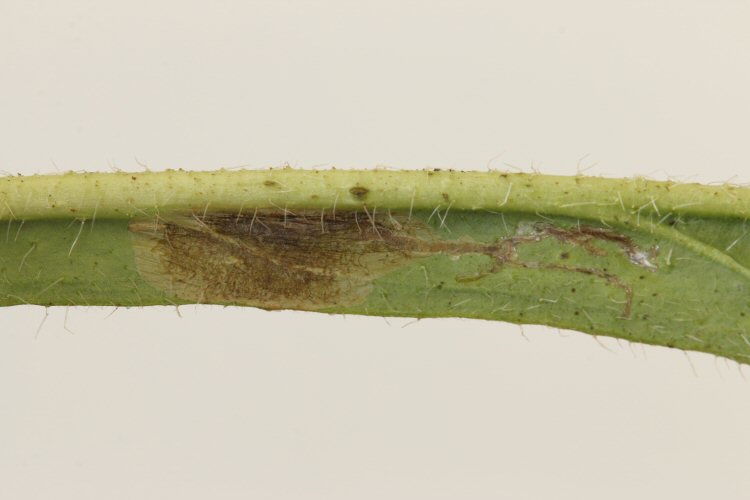
Notes: Initially forms a narrow twisting gallery which then forms an elongated blotch mine by the midrib, with a wrinkled surface, which may absorb this early gallery. The mine is usually lower surface and inconspicuous if viewed from above (Langdon, 2023). A mine on the underside of a leaf of Echium vulgare, with the thin initially gallery opening out into a large shallow blotch, with a puckered surface and stringy brown frass. The yellow larva is just visible feeding in the topleft of the blotch. Mines are mostly on the underside of the leaf (54 out of 56 at Dungeness were), and being very shallow, are rarely visible from above except perhaps by some distortion of the leaf edge, or very rarely, brown windows in the leaf. The early galleries and blotches turn brown on ageing. There may be more than one mine in a leaf and these may merge into one blotch. Pupation is within the mine in a silken cocoon. First recorded in the UK in Kent (2004), when a moth was trapped. This is the third British record and the first of the moth being bred (Langdon, 2023). A predominantly Southern European species.
Data: 01.x.2022, Dungeness, Kent, VC15
Image:© Will Langdon
sponsored by Colin Plant Associates (UK) LLP/Consultant Entomologists